
Third/Multiplication
Multiplication with Arrays - Count and Multiply ()
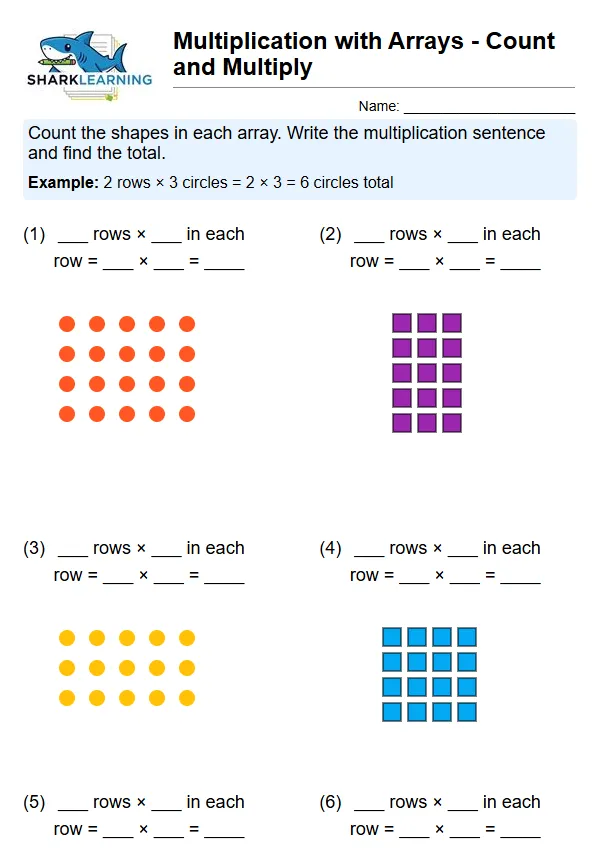
Practice counting objects arranged in arrays and writing multiplication sentences. Students see visual arrays of shapes arranged in rows and columns. Helps students connect visual representations to multiplication.
0
Sheets
1835
Views
232
Downloads
Preview
Click to preview collection
Teacher Resources
Standards
3.OA.A.1, 3.OA.A.3Printable Aids
Grid paperDot arrays
Teaching Notes
Introduce arrays as a visual model for multiplication, connecting rows/columns to factors. Emphasize that multiplication is repeated addition.
Vocabulary
Array: Objects arranged in rows and columns.
Multiply: Combine equal groups to find a total.
Common Mistakes
- Mixing up rows (horizontal) and columns (vertical).
- Counting perimeter instead of area/total.
- Counting individual objects instead of groups/factors.
- Confusing the number of rows with the number of columns.
- Writing repeated addition instead of a multiplication sentence.
Differentiation
SupportUse physical manipulatives to build arrays and count them.
ChallengeDraw arrays for given multiplication facts; explore the commutative property.
Discussion Questions
- Where do you see arrays in the real world?
- How is multiplication with arrays like repeated addition?
- What happens if you swap the number of rows and columns?
- How do arrays help you understand multiplication facts?
Extension Activities
- Build arrays with objects.
- Draw multiplication arrays.
- Count items in arrays.
Parent Tip
Use buttons or blocks to create arrays and practice multiplication.
Learning Path
Skill Cluster
Multiplication Concepts
Estimated Time
20 minutes
Skills Practiced
Visualizing multiplicationRow/Column terminology
Prerequisites
- Multiplication as Repeated Addition
- Counting objects in equal groups
- Repeated addition concepts
Next Steps
- Commutative property of multiplication
- Solving array word problems
- Larger arrays
- Multiplication: Equal Groups
- Repeated Addition to Multiply
- Commutative Property of Multiplication