
Money Word Problems
Browse 5 Money Word Problems worksheets for Grade 3 Math. These Measurement worksheets are designed to give students targeted practice and build confidence in math.
Choose from Easy, Medium, Hard worksheets in this collection. Use the PDF and Key buttons to see available downloads. Pro labels indicate membership access; account requirements are shown when you download.
Whether you're a teacher looking for measurement practice problems, a homeschool parent building a Grade 3 curriculum, or a tutor helping a student catch up, choose an available worksheet that matches what your student is practising.
Preview
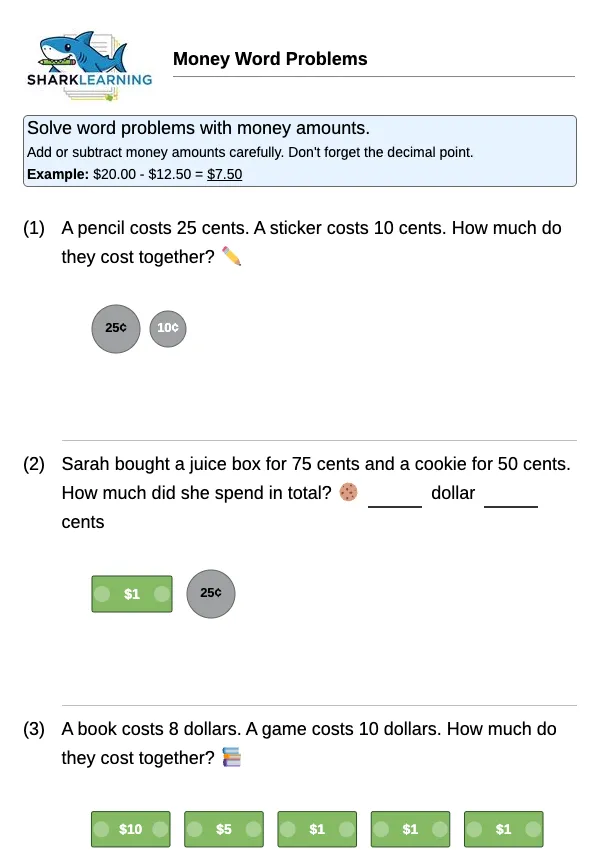
Tap to open PDF
Prerequisites
Practice Questions
- You buy a toy 🧸 for $12.50 and pay with a $20 bill. How much change do you get?
Show answer
$7.50
- A notebook 📓 costs $2.25. How much do 4 notebooks cost?
Show answer
$9.00
- You have $10.00 💵. You spend $3.50 on lunch and $2.00 on a drink. How much is left?
Show answer
$4.50
- A video game 🎮 costs $45.00. You save $5.00 a week. How many weeks until you can buy it?
Show answer
9 weeks
- Three friends 🧑🤝🧑 share a pizza that costs $15.00. How much does each person pay?
Show answer
$5.00
Preview
Click to preview collection
Quick Tip
Teacher Resources
Teaching Notes
This collection focuses on money word problems. Encourage students to underline key numbers and words in the problem.
Vocabulary
Common Mistakes
- Not converting units before calculating (e.g., subtracting meters from kilometers)
- Misplacing the decimal point in money problems
- Confusing AM and PM in time problems
- Misidentifying required operation
- Incorrect decimal alignment
- Calculation errors with cents
- Ignoring units ($ / ¢)
Differentiation
Discussion Questions
- How do you know which operation (add, subtract, multiply, divide) to use?
- Why is it important to check your units?
- How can estimation help you check if your answer is reasonable?
- How do we use money calculations in everyday life?
- Why is it important to be precise with money?
- What strategies help you solve word problems?
- How do you check if your answer makes sense?
Extension Activities
- Create a class store where students buy and sell items.
- Plan a trip and calculate distances and travel times.
- Bake a recipe and adjust the quantities for a larger group.
Parent Tip
Involve your child in simple shopping calculations at the store.
Learning Path
Skill Cluster
Number Sense & Operations; Financial Literacy
Estimated Time
20 minutes