
Grade 3/Measurement
Estimating Lengths
Estimate lengths of objects and distances using benchmarks and number sense. Students learn to use known references (thumb ≈ inch, paper ≈ foot) to make reasonable estimates. Critical real-world skill for situations where exact measurement isn't possible or practical.
6
Sheets
1916
Views
431
Downloads
Preview
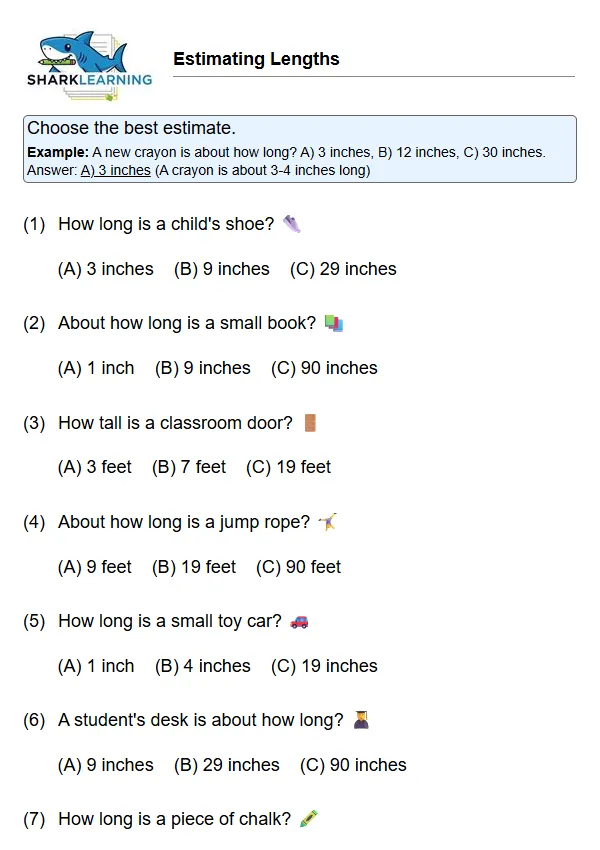
Tap to open PDF
Practice Questions
- Estimate the length of a dollar bill in inches. Circle your best guess. (A) less than 2 inches (B) about 6 inches (C) more than 17 inches
Show answer
(B) about 6 inches
- Estimate the length of your foot in inches. Circle your best guess. (A) less than 4 inches (B) about 9 inches (C) more than 20 inches
Show answer
(B) about 9 inches
- Estimate the length of a school hallway in feet. Circle your best guess. (A) less than 47 feet (B) about 85 feet (C) more than 130 feet
Show answer
(B) about 85 feet
- Estimate the length of a dollar bill in inches. Circle your best guess. (A) less than 2 inches (B) about 6 inches (C) more than 17 inches
Show answer
(B) about 6 inches
- Estimate the length of your foot in inches. Circle your best guess. (A) less than 4 inches (B) about 9 inches (C) more than 20 inches
Show answer
(B) about 9 inches
Preview
Click to preview collection
Teacher Resources
Teaching Notes
Estimation is critical real-world skill. Teach benchmarks: inch ≈ thumb width, foot ≈ sheet of paper length, yard ≈ arm span. Strategy: compare to known object. Practice: estimate first, then measure to check. Discuss reasonableness. Don't expect exact answers - range is fine.
Vocabulary
Estimate: Make a smart guess about a measurement.
Length: How long something is.
Common Mistakes
- Wild guesses without reasoning
- Confusing units
- Not using benchmarks
- Confusing units (inch vs. foot)
- Guessing instead of reasoning
- Estimating too precisely
Differentiation
SupportProvide additional scaffolding, use manipulatives, break down into smaller steps, allow more time.
ChallengeChallenge with extension activities, create own problems, explore deeper connections, work with larger numbers or more complex scenarios.
Discussion Questions
- What can we use as a benchmark for 1 inch?
- Why is estimation useful?
- Does estimate have to be exact?
- When do we estimate length in everyday life?
- Why is a reasonable estimate helpful?
- What benchmarks help you estimate length?
- How do you know if an estimate is too big or too small?
Extension Activities
- Benchmark body parts
- Estimate distances around school
- Compare estimates with actual measurements
Parent Tip
Ask your child to estimate the length of everyday items before measuring.
Learning Path
Skill Cluster
Measurement
Estimated Time
15 minutes
Skills Practiced
Estimate lengthUse benchmarksReasonable estimates