
Third/Counting Money
Comparing Money Values ()
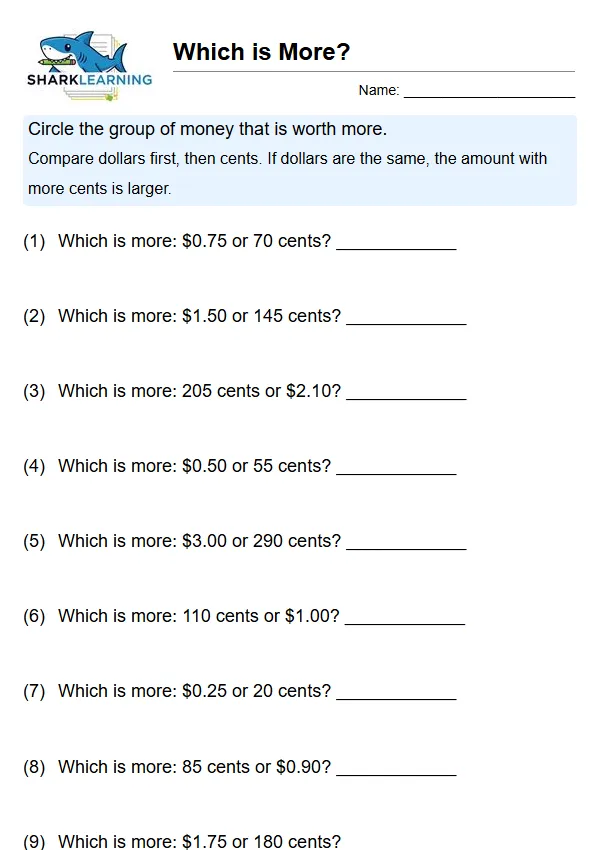
Compare two money amounts to determine which is greater. Students practice analyzing dollars and cents to make accurate comparisons.
0
Sheets
1566
Views
220
Downloads
Preview
Click to preview collection
Quick Tip
Compare dollars first, then cents. If dollars are the same, the amount with more cents is larger.
Teacher Resources
Teaching Notes
Emphasize place value when comparing money amounts, starting from the largest denomination (dollars) and moving to cents. Discuss real-world scenarios where comparing money is essential.
Vocabulary
Value: How much money a coin or bill is worth.
Compare: Look at two or more things to see how they are alike or different.
Common Mistakes
- Ignoring the decimal point and comparing only the visible numbers.
- Comparing only cents first, without considering the dollar amounts.
- Misunderstanding the relative value of different coins (e.g., mistaking a nickel for a dime).
Differentiation
SupportStart with coins only, then dollars only, before mixing.
ChallengeCompare three money amounts, or include word problems.
Discussion Questions
- How do we decide which money amount is greater?
- Why is understanding place value crucial when comparing dollars and cents?
- Can you give an example of when you would need to compare money in real life?
- What strategies help you compare amounts accurately and quickly?
Extension Activities
- Sort coins by value.
- Make different amounts with coins.
- Play store with play money.
Parent Tip
Ask your child to compare prices of items at the grocery store.
Learning Path
Skill Cluster
Money & Financial Literacy
Estimated Time
15 minutes
Skills Practiced
counting coinscomparing valuesmoney math
Prerequisites
- Counting Money (Dollars & Cents)
- Understanding Place Value (to hundredths)
Next Steps
- Adding Money
- Subtracting Money
- Making Change
- Counting Money