
Find Missing Amount: Whole Minus Mixed Result
Preview
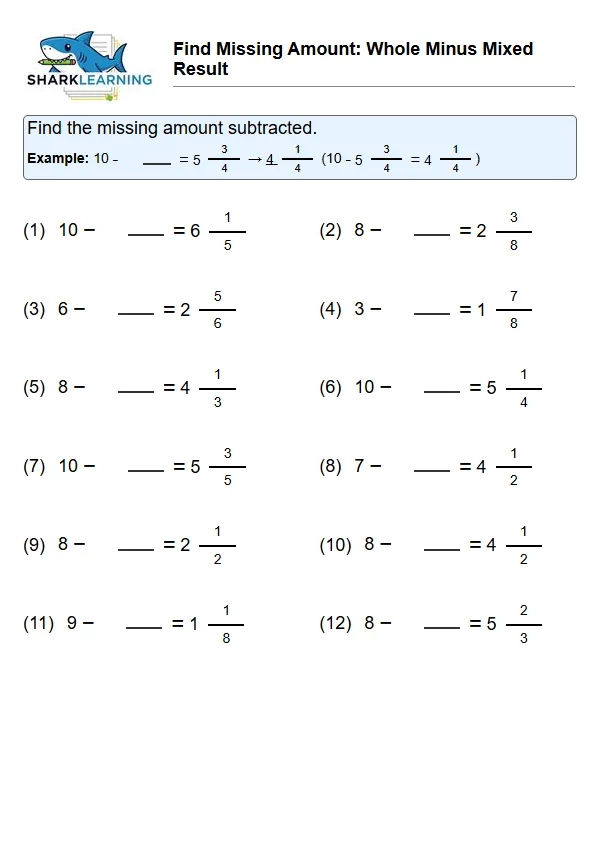
Tap to open PDF
Prerequisites
Practice Questions
- 10 - ? = 5 3/4
Show answer
4 1/4
- 8 - ? = 3 2/5
Show answer
4 3/5
- 6 - ? = 2 5/6
Show answer
3 1/6
- 12 - ? = 7 1/3
Show answer
4 2/3
- 9 - ? = 4 3/8
Show answer
4 5/8
Preview
Click to preview collection
Teacher Resources
Teaching Notes
This is algebraically challenging - students must think backwards. Strategy: Subtract the given result from the starting whole to find what was removed. Example: 10 - ___ = 5 3/4 means "what do I subtract from 10 to get 5 3/4?" Answer: 10 - 5 3/4 = 4 1/4. Use real scenarios: "I had $10, bought something, now have $5.75. How much did I spend?" Number lines help visualize: start at 10, end at 5 3/4, measure the distance (that's what was subtracted). This builds foundation for solving equations with unknowns. Emphasize the thinking: "If I take away ___ from 10, I get 5 3/4."
Vocabulary
Common Mistakes
- Adding instead of subtracting (10 + 5 3/4)
- Subtracting in wrong order (5 3/4 - 10)
- Confusion about what the blank represents
- Not converting whole properly when subtracting mixed number
- Forgetting to regroup
- Incorrect fraction subtraction
- Not converting whole number
- Denominator errors
Differentiation
Discussion Questions
- How do you figure out what was subtracted?
- Why does this problem require backwards thinking?
- Can you show 10 - ? = 5 3/4 on a number line?
- What real situations involve finding missing amounts?
- How is this like solving an equation in algebra?
- How is this related to regular whole number subtraction?
- Why is converting the whole number crucial here?
- What are common pitfalls to avoid when solving these problems?
- How can you check your answer to ensure accuracy?
Extension Activities
- Real-world problem creation: money spent, distance traveled, time passed
- Visual modeling with number lines showing start, end, and distance
- Pattern investigation: What happens with different starting wholes but same result?
- Game: Given result and starting point, race to find missing amount
- Connection exploration: How is this like missing addend problems?
Parent Tip
Use a ruler to demonstrate subtracting a length from a whole length.
Learning Path
Skill Cluster
Number Sense and Operations: Fractions
Estimated Time
15 minutes