
Fourth/Multiplication
Arrays to Multiplication Sentences ()
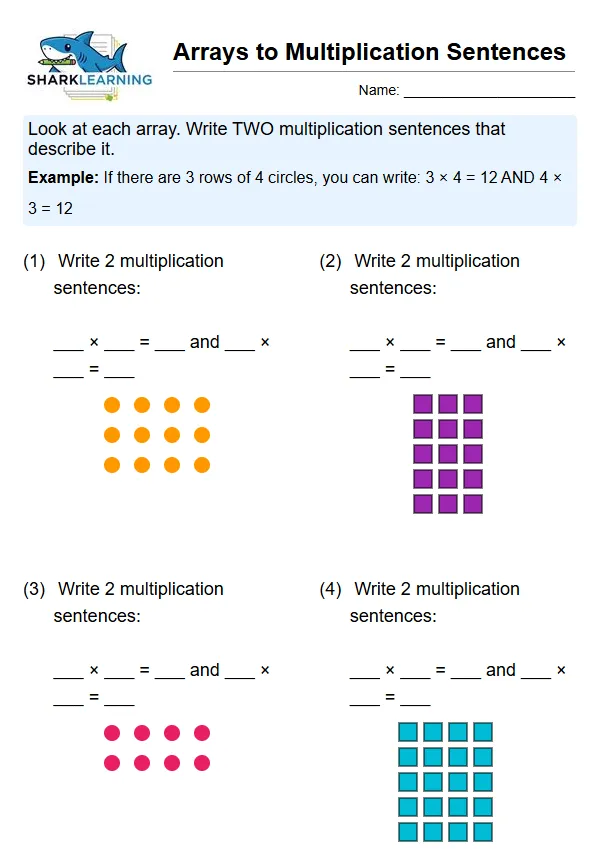
Write both multiplication sentences for each array. Students learn that arrays can be described in two ways showing the commutative property. Helps students understand that order doesn't matter in multiplication.
0
Sheets
1879
Views
315
Downloads
Preview
Click to preview collection
Teacher Resources
Standards
3.OA.A.1, 3.OA.B.5Printable Aids
Rotatable array cards
Teaching Notes
This collection helps students visualize multiplication through arrays and understand the commutative property. Emphasize that rotating an array changes the factors but not the product.
Vocabulary
Array: Objects arranged in rows and columns.
Factor: Numbers multiplied to get a product.
Common Mistakes
- Thinking 3x5 and 5x3 are different totals.
- Forgetting the product.
- Only writing one multiplication sentence per array.
- Confusing rows and columns when forming sentences.
- Not understanding that the product remains the same.
Differentiation
SupportUse smaller arrays and physical manipulatives for building.
ChallengeChallenge to explain *why* the commutative property works.
Discussion Questions
- How does an array show multiplication?
- What happens when you turn an array on its side?
- Can you give an example of the commutative property in real life?
- Why is it helpful to know that order doesn't matter in multiplication?
Extension Activities
- Build arrays with LEGOs.
- Draw arrays for objects.
- Find arrays in the real world.
Parent Tip
Use objects like coins or toys to build arrays and write sentences.
Learning Path
Skill Cluster
Multiplication Foundations
Estimated Time
20 minutes
Skills Practiced
Commutative propertyWriting equations
Prerequisites
- Multiplication with Arrays
- Understanding of equal groups
- Repeated addition
- Introduction to arrays
Next Steps
- Multiplication fact fluency
- Relating arrays to area
- Introduction to division with arrays
- Array Word Problems
- Commutative Property Practice
- Introduction to Area