
Subtract Mixed Numbers with Regrouping (Like Denominators)
Preview
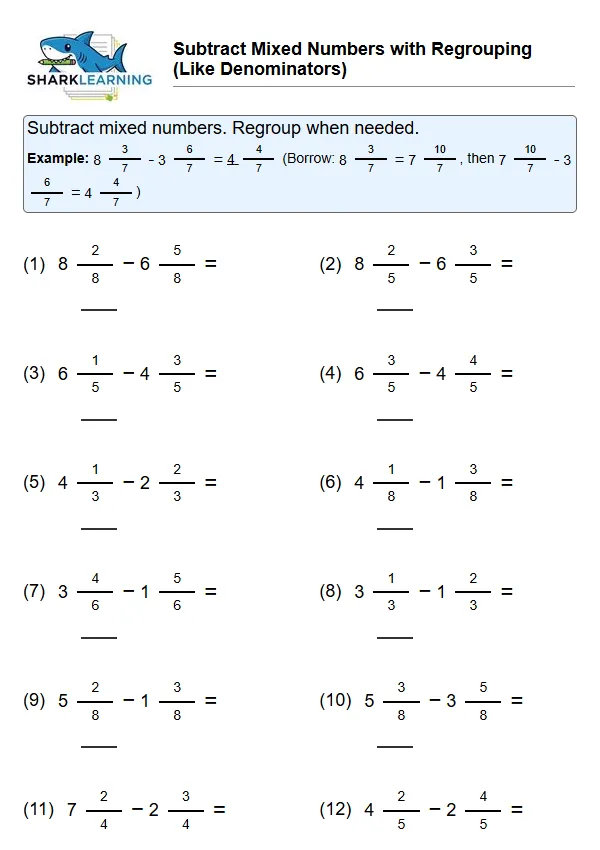
Tap to open PDF
Practice Questions
- 8 3/7 - 3 6/7 = ?
Show answer
4 4/7
- 6 2/5 - 2 4/5 = ?
Show answer
3 3/5
- 5 1/4 - 2 3/4 = ?
Show answer
2 2/4
- 7 3/8 - 4 5/8 = ?
Show answer
2 6/8
- 9 2/6 - 5 5/6 = ?
Show answer
3 3/6
Preview
Click to preview collection
Teacher Resources
Teaching Notes
This is the pinnacle of like-denominator fraction operations. Teach systematic borrowing: (1) Compare fractions - can you subtract? (2) If not, borrow 1 from whole number, (3) Convert that 1 to a fraction with matching denominator, (4) Add to existing fraction, (5) Now subtract both parts. Example: 6 2/5 - 3 4/5 → can't subtract 4/5 from 2/5, so borrow: 6 2/5 = 5 7/5 (because 1 = 5/5, and 5/5 + 2/5 = 7/5). Then 5 - 3 = 2, and 7/5 - 4/5 = 3/5, giving 2 3/5. Connect to borrowing in regular subtraction. Use visual models showing the borrowing process. This prepares for all advanced fraction work.
Vocabulary
Common Mistakes
- Not recognizing when borrowing is needed
- Incorrectly converting 1 whole to fraction form
- Forgetting to reduce the whole number when borrowing
- Adding the borrowed fraction wrong (forgetting to add to existing fraction)
- Subtracting whole numbers incorrectly after borrowing
- Forgetting to reduce the whole number after borrowing.
- Subtracting smaller fraction from larger without borrowing.
- Incorrectly converting 1 whole (e.g., 1 = 3/4 instead of 4/4).
- Errors in basic fraction subtraction after borrowing.
Differentiation
Discussion Questions
- How do you know when you need to borrow?
- Why do we convert 1 to a fraction with the matching denominator?
- How is this like borrowing when subtracting whole numbers like 52 - 37?
- Can you explain each step of 8 3/7 - 3 6/7?
- What makes this the hardest type of fraction subtraction?
- When do you need to borrow in mixed number subtraction?
- How is borrowing with fractions like borrowing whole numbers?
- Explain how 1 whole can be written as different fractions.
- Why is understanding borrowing crucial for fraction operations?
Extension Activities
- Step-by-step visual guides showing the borrowing process
- Real-world problems requiring mixed number subtraction with borrowing
- Error analysis: Find and fix mistakes in worked problems
- Pattern exploration: Relationship between numerators and when borrowing is needed
- Create a teaching poster explaining mixed number subtraction with borrowing
Parent Tip
Ask your child to explain how they borrowed to solve a problem.
Learning Path
Skill Cluster
Number Operations with Fractions
Estimated Time
16 minutes