
Subtract Fraction from Whole Number
Preview
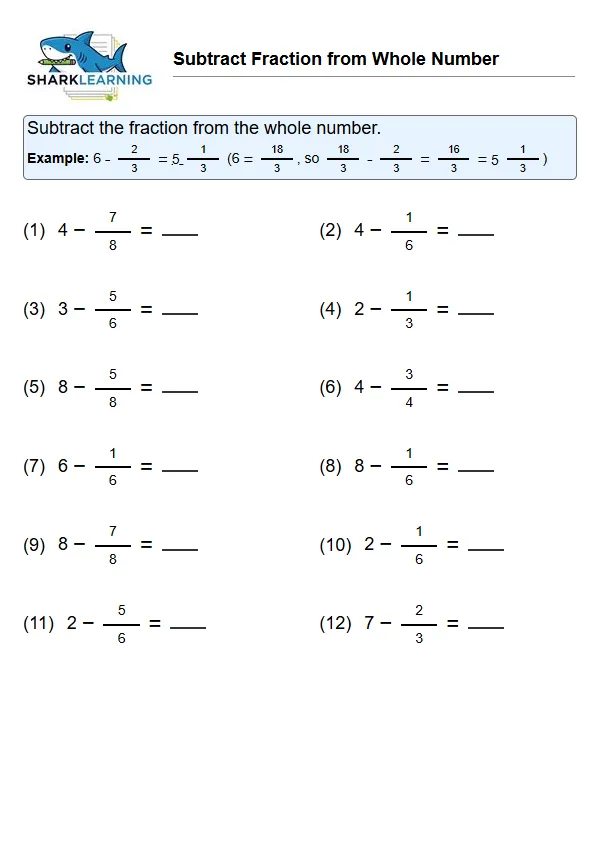
Tap to open PDF
What to Do Next
Practice Questions
- 6 - 2/3 = ?
Show answer
5 1/3
- 4 - 1/5 = ?
Show answer
3 4/5
- 3 - 3/4 = ?
Show answer
2 1/4
- 5 - 2/6 = ?
Show answer
4 4/6
- 2 - 5/8 = ?
Show answer
1 3/8
Preview
Click to preview collection
Teacher Resources
Teaching Notes
This is challenging because students must convert the whole number to match the fraction's denominator. Teach strategy: (1) Convert whole to fraction with matching denominator (multiply whole by denominator over denominator), (2) Subtract fractions normally, (3) Convert improper fraction result to mixed number. Example: 4 - 1/5 → 20/5 - 1/5 = 19/5 = 3 4/5. Use visuals: draw whole rectangles, divide into pieces matching the denominator, then remove the fractional amount. Real applications: "You have 3 whole pizzas and serve 5/8 of a pizza, how much remains?" This builds deep understanding of wholes as composed of fractional parts.
Vocabulary
Common Mistakes
- Not converting the whole number to a fraction
- Multiplying incorrectly to create matching denominator
- Forgetting to convert final answer to mixed number
- Subtracting whole number minus numerator (4 - 1/5 = 3/5)
- Forgetting to convert whole number.
- Subtracting numerator from whole.
- Incorrectly finding equivalent fraction.
- Errors in mixed number conversion.
Differentiation
Discussion Questions
- Why do we need to convert the whole number to a fraction?
- How do you know what denominator to use?
- Can you show 3 - 2/5 using pictures?
- What real situations require subtracting a fraction from a whole?
- How is this similar to "borrowing" when subtracting regular numbers?
- Why must the whole number be converted?
- How do equivalent fractions help here?
- What is the connection to mixed numbers?
- Can this be modeled visually?
Extension Activities
- Visual modeling: Draw and solve whole-minus-fraction problems
- Real-world scenarios: leftover materials, remaining time in activities
- Pattern exploration: 5 - 1/4, 5 - 2/4, 5 - 3/4, 5 - 4/4... what pattern?
- Estimation practice: Before solving, estimate whether answer will be near original whole
- Conversion practice: Express same whole multiple ways (3 = 6/2 = 9/3 = 12/4...)
Parent Tip
Ask your child to measure out a length, then cut off a small piece.
Learning Path
Skill Cluster
Fraction Operations
Estimated Time
14 minutes