
Grade 4/Fractions
Convert Decimals to Mixed Numbers
Students practice converting decimals greater than one into mixed number form, recognizing that decimals can represent whole numbers plus fractional parts. Working with values like 7.3 (which becomes 7 3/10) or 2.5 (which becomes 2 5/10 or 2 1/2), students develop flexibility moving between decimal and fraction representations. This skill reinforces place value understanding and shows that mathematical values can be expressed in multiple equivalent forms. Students learn that the whole number part stays the same, while the decimal portion converts to a fraction with denominator 10 or 100. This builds number sense crucial for measurement, money calculations, and scientific notation.
6
Sheets
1712
Views
283
Downloads
Preview
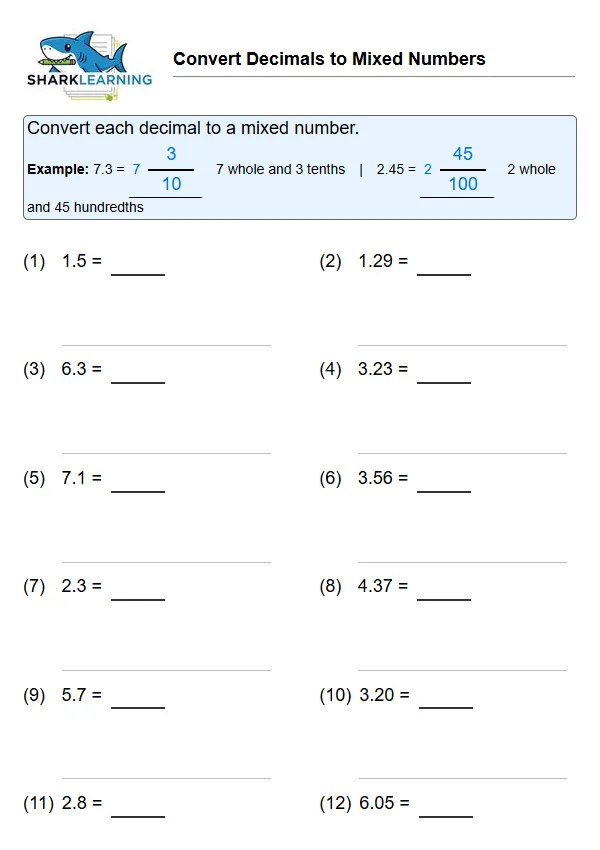
Tap to open PDF
Prerequisites
What to Do Next
Practice Questions
- 7.3 = ?
Show answer
7 310
- 2.5 = ?
Show answer
2 510 or 2 12
- 4.1 = ?
Show answer
4 110
- 9.7 = ?
Show answer
9 710
- 3.9 = ?
Show answer
3 910
Preview
Click to preview collection
Teacher Resources
Teaching Notes
Teach the two-step process: (1) The whole number part stays the same, (2) Convert the decimal part to a fraction (one decimal place → tenths, two decimal places → hundredths). Example: 7.3 → 7 (stays) + 0.3 (becomes 3/10) = 7 3/10. Use money: $7.30 is 7 dollars and 30 cents, or 7 dollars and 30/100 of a dollar. Some decimals simplify beautifully: 2.5 = 2 5/10 = 2 1/2. Accept both forms initially. Place value charts help students see ones | tenths | hundredths columns. Connect to measurement: 4.2 meters is 4 whole meters plus 2 tenths of a meter.
Vocabulary
Decimal: A number shown with a decimal point.
Mixed Number: A whole number and a fraction.
Common Mistakes
- Converting the whole number part (7.3 becoming something other than 7)
- Wrong denominator (using 100 when decimal has one place, or 10 when it has two)
- Writing 0.3 as 3/100 instead of 3/10
- Forgetting the whole number in the final answer
- Forgetting the whole number
- Incorrect denominator (10 vs 100)
- Not simplifying the fraction
- Misplacing the decimal point
Differentiation
SupportUse place value mats: physically separate whole number blocks from decimal blocks. Start with simple one-decimal-place numbers only. Provide a step-by-step checklist: "Step 1: Write the whole number. Step 2: Look at decimal places. Step 3: Write decimal part as fraction." Use base-10 blocks to model. Color-code: wholes in one color, fractional parts in another.
ChallengeInclude decimals that simplify (like 2.5 = 2 1/2, 4.25 = 4 1/4). Challenge: "Express 3.6 three different ways" (3 6/10, 3 3/5, as improper fraction). Ask students to compare: "Which is easier to understand: 5.75 or 5 3/4?" Mixed practice with fraction-to-decimal conversions. Connect to real measurements and money amounts.
Discussion Questions
- Why does the whole number part stay the same?
- How do you know whether to use tenths or hundredths?
- Which form is easier for you: 3.5 or 3 1/2? Why?
- Can you show 7.3 using base-10 blocks?
- When might you want to use a mixed number instead of a decimal?
- How does place value relate to converting decimals?
- Why is 0.5 equivalent to 1/2?
- When is a mixed number more useful than a decimal?
- Can you write 3.25 in other ways?
Extension Activities
- Measurement conversion: Express heights, weights, distances as both decimals and mixed numbers
- Money scenarios: Convert dollar amounts to mixed number form
- Create equivalent expression posters (7.5 = 7 1/2 = 7 5/10 = 15/2)
- Real-world decimal collection: Find examples, convert to mixed numbers
- Pattern exploration: What happens when decimal part increases?
Parent Tip
Ask your child to read decimals aloud, like 'three point five'.
Learning Path
Skill Cluster
Number Sense & Fraction/Decimal Equivalence
Estimated Time
13 minutes
Skills Practiced
Decimal to mixed conversionSeparating wholes partsDecimal place recognitionEquivalent forms