
First/Telling Time
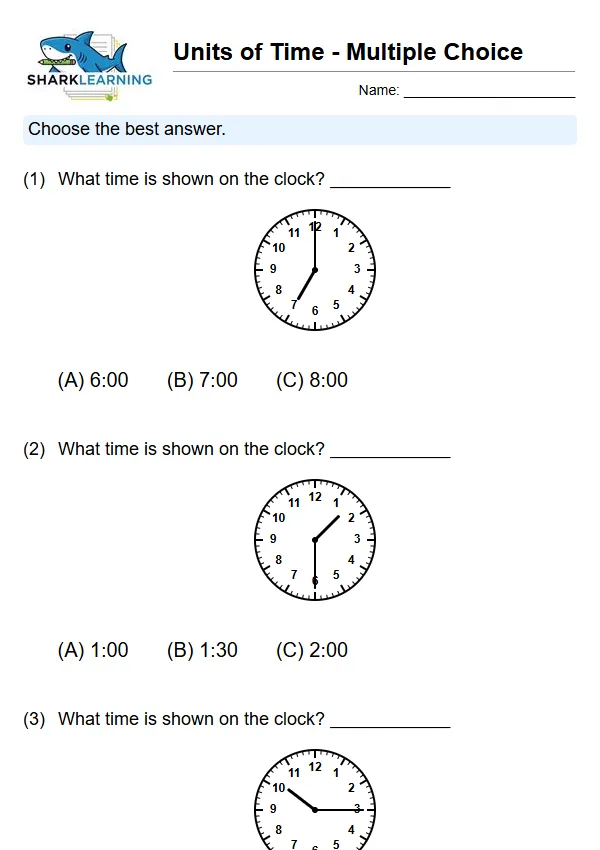
Units of Time: Multiple Choice ()
Choose the best answer for each question.
0
Sheets
1806
Views
413
Downloads
Preview
Click to preview collection
Teacher Resources
Teaching Notes
Introduce time units using real-world examples and a calendar. Emphasize the cyclical nature of some units.
Vocabulary
Second: The shortest unit of time.
Minute: Sixty seconds make one minute.
Hour: Sixty minutes make one hour.
Common Mistakes
- Confusing units (e.g., minutes vs. seconds)
- Incorrect number of days in months
- Misunderstanding AM/PM duration
- Forgetting 60 minutes/seconds
Differentiation
SupportUse visual aids like clocks and calendars. Focus on fewer units at a time.
ChallengeIntroduce elapsed time problems. Explore more complex unit conversions.
Discussion Questions
- Why do we need different units of time?
- What activities fit best with each unit?
- How do hours, minutes, and seconds relate?
- How is a calendar organized by units of time?
Extension Activities
- Time everyday activities.
- Compare durations.
- Use a timer for games.
Parent Tip
Ask your child to estimate time for daily tasks like getting dressed.
Learning Path
Skill Cluster
Measurement & Time
Estimated Time
15 minutes
Skills Practiced
time estimationunits of timereal world time
Prerequisites
- Ordering Events by Time
- Telling Time to the Hour
Next Steps
- Converting Time Units
- Calculating Elapsed Time
- Telling Time to the Nearest Five Minutes
- Time Word Problems: Duration