
First/Telling Time
Reading Clocks: Full Hours ()
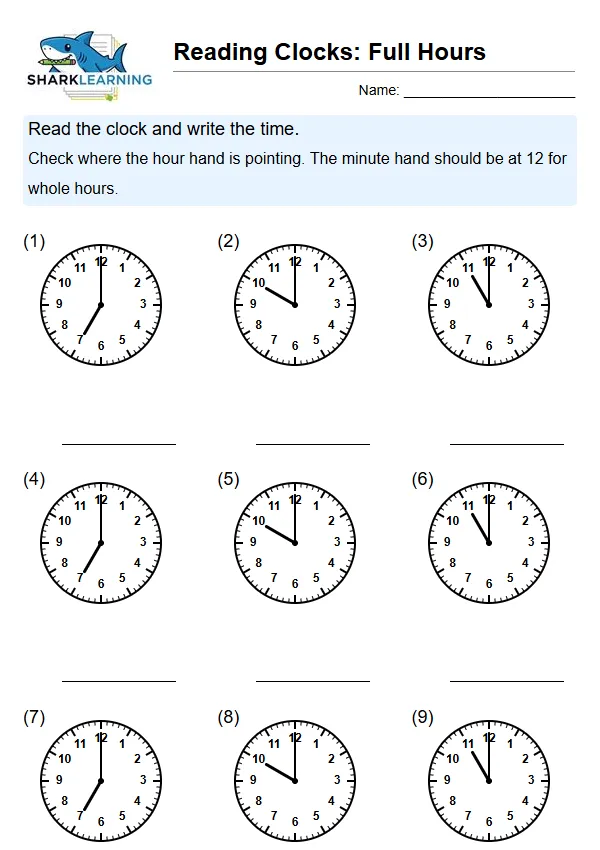
Practice reading analog clocks to the hour. These worksheets help Grade 2 students learn to tell time to the hour using clear clock faces. Perfect for building time-telling skills.
0
Sheets
1393
Views
100
Downloads
Preview
Click to preview collection
Quick Tip
Check where the hour hand is pointing. The minute hand should be at 12 for whole hours.
Teacher Resources
Teaching Notes
Emphasize the distinction between the hour and minute hands. Practice identifying the hour hand's position first, then the minute hand.
Vocabulary
Hour hand: The short hand on an analog clock.
Minute hand: The long hand on an analog clock.
Common Mistakes
- Confusing the hour and minute hands.
- Misinterpreting the minute hand's position (e.g., reading 12 as 0 minutes).
- Not recognizing that 'o'clock' means the minute hand points to 12.
Differentiation
SupportUse a digital clock alongside analog for comparison.
ChallengeChallenge by asking for daily activities at specific hours.
Discussion Questions
- What do you do at 7 o'clock in the morning?
- Why is the minute hand always on the 12 for 'o'clock'?
- How does the hour hand tell us what time it is?
- Can you name something that happens every hour?
Extension Activities
- Set an alarm for a full hour.
- Draw clocks showing full hours.
- Play 'What time is it?' game.
Parent Tip
Ask your child to point to the hour hand and tell you the hour.
Learning Path
Skill Cluster
Measurement and Data
Estimated Time
15 minutes
Skills Practiced
reading analog clockstelling time to the hourhour hand identification
Prerequisites
- Recognizing numbers 1-12
- Understanding basic clock components
Next Steps
- Telling Time to the Half Hour
- Telling Time to the Quarter Hour
- Telling Time: Digital Clocks