
First/Geometry
Shape Identification ()
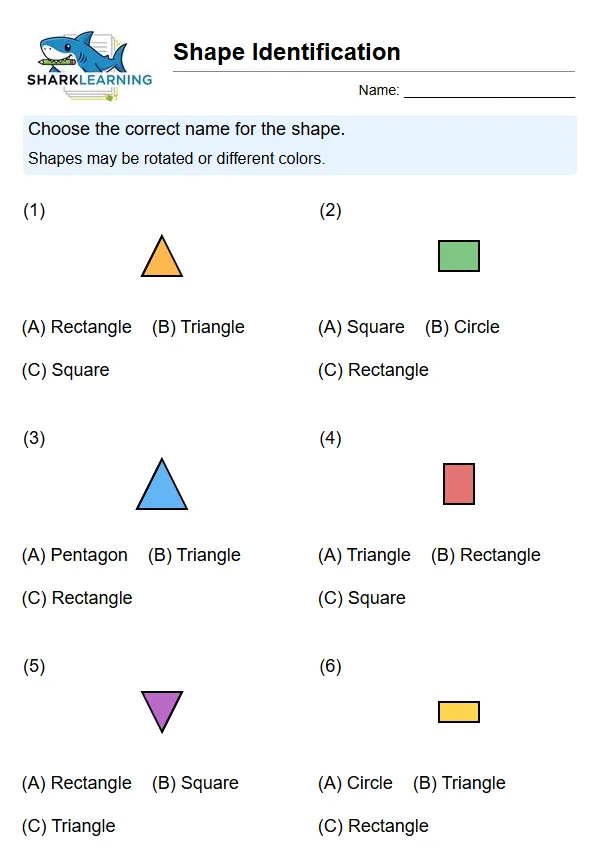
Look at each shape and choose the correct name.
0
Sheets
1676
Views
327
Downloads
Preview
Click to preview collection
Quick Tip
Shapes may be rotated or different colors.
Teacher Resources
Standards
CCSS.MATH.CONTENT.2.G.A.1Teaching Notes
Focus on recognizing defining attributes of 2D shapes, like the number of sides and vertices. Encourage students to articulate how shapes are similar or different.
Vocabulary
Shape: A closed figure with specific properties.
Side: A straight line forming part of the shape.
Corner: A point where two sides meet.
Common Mistakes
- Confusing similar polygons (e.g., rhombus and square, rectangle and trapezoid).
- Overlooking that orientation or size does not change a shape's name.
- Misidentifying non-polygons like ovals or crescents with polygons.
Differentiation
SupportProvide shape manipulatives for tactile recognition.
ChallengeChallenge to describe shapes using geometric vocabulary.
Discussion Questions
- How can you tell a square is different from a rectangle?
- What shapes have no straight sides?
- Can a triangle look upside down? Is it still a triangle?
- Where do you see these shapes in our classroom or at home?
Extension Activities
- Draw different shapes.
- Find shapes in nature.
- Build shapes with blocks.
Parent Tip
Point to objects and ask your child to name their shape.
Learning Path
Skill Cluster
Geometry and Spatial Reasoning
Estimated Time
15 minutes
Skills Practiced
identifying 2d shapescounting sidescounting corners
Prerequisites
- Visual Discrimination
- Basic Object Naming
Next Steps
- Shape Attributes
- Composing Shapes
- Shape Attributes: Sides and Vertices
- Comparing 2D Shapes
- 3D Shape Identification